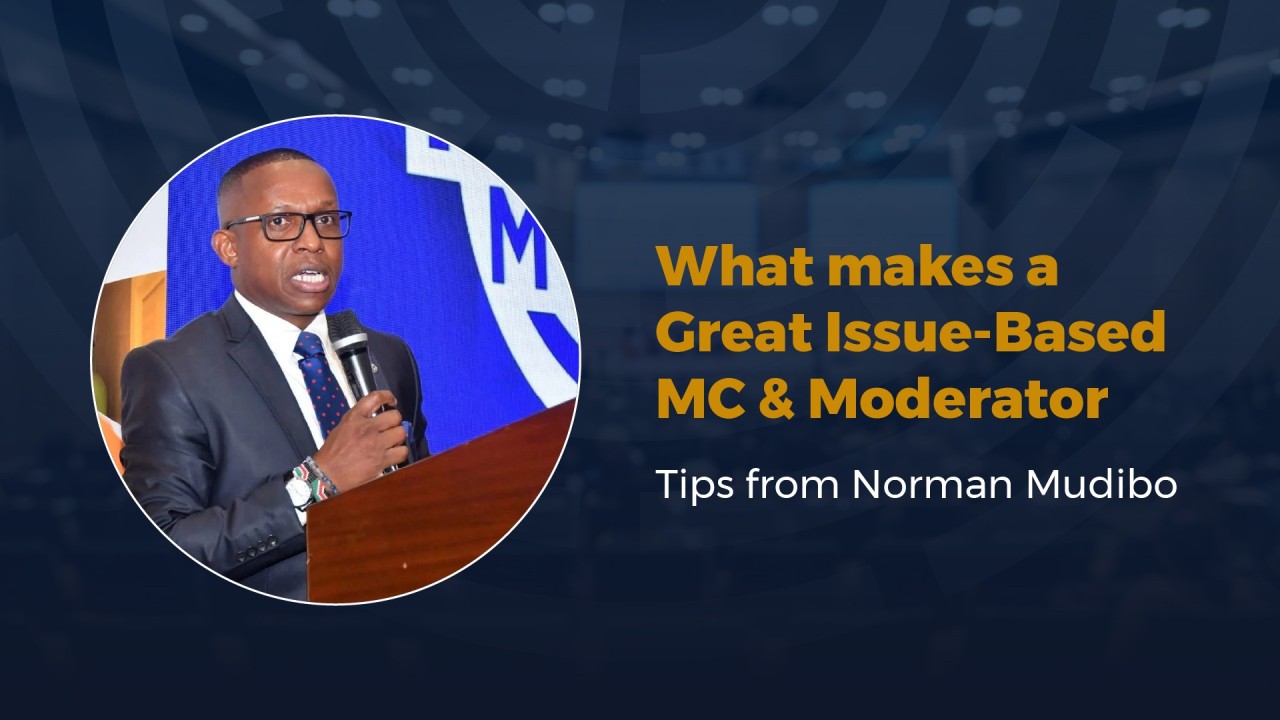
I saunter into a ballroom, exchange pleasantries, check the time and signal the sound people. As I climb up the podium, the low hum of private conversations begins to taper into a collective expectant silence, and the air in the room grows heavy with the scent of high-stakes expectations. In that heartbeat of time, before the first syllable leaves my lips, I am not merely a man with a microphone. I am the conductor of an intellectual symphony, and the bridge between a sea of curious minds and a stage full of specialised wisdom. Welcome to the world of the Issue-Based MC and Moderator!
Folks, the role of an overall Program Director, MC, and Moderator could be mistaken for little more than filling pauses between speakers. The polished suit and the easy smile may make one assume that the role is as easy as pie. But unlike a purely ceremonial MC role—which is primarily about warming up the crowd and keeping the energy high—moderating business forums or corporate conferences is a different ball game entirely.
I have handled both several times. I have come to realise that being a moderator for such high-level meetings or events is a horse of a different colour. It is the difference between a pleasant stroll in the park and a high-wire act across a canyon during a gale-force wind. When you are the one responsible for speaker coordination and panel management involving diverse opinions and complex data, you are the glue that holds the entire structure together. It requires grace, grit, and a gravitas that commands the room. You need unwavering focus and on-stage professionalism to drive message alignment and achieve critical objectives.
The Boardroom Ambush
My entry into the world of professional emceeing was not a planned career move; it was a baptism by fire. One February morning in 2014, I was sitting in the Family Bank boardroom, still smelling of ‘new hire’ energy, having only been the Communications lead for a few days. To my side sat the Chairman, Wilfred Kiboro—a man who carried the gravitas of his former role as Nation Media Group CEO. He later became the Chairman. Having watched me carve out a niche in TV business journalism under his watch, he knew my capabilities, took a chance on me for what turned out to be a defining moment in this journey.
The air in the room was thick with the silent hum of high-level event planning until the Chairman gestured toward me. With the casual ease of someone tossing a pebble into a pond, he looked at everyone in the room. The sudden announcement that I would be the Master of Ceremonies for the launch of the Family Group Foundation jolted me. This was not just any ribbon-cutting; the guest of honour was the Deputy President in a who-is-who event.
The room went quiet. A few colleagues offered sympathetic smiles, the kind you give someone about to walk a tightrope for the first time. I tried to mount a subtle objection, but my protest was dead in the water. The Chairman’s word was final.
From the Newsroom to PR and Communication, to the Podium
While I felt like a fish out of water in that moment, he saw the bigger picture. He banked on my years of TV experience—the hundreds of hours spent scripting and reporting on complex financial and business issues—as the perfect foundation. To him, the transition from the screen to communication onto the stage was as natural as a duck taking to water. That single event composed of high-profile speakers, which I approached with a heart hammering like a drum, turned out to be the spark. What started as a command performance has now become a core pillar of my professional identity.
Today, whether I am moderating a high-level corporate panel or hosting a business summit, I carry that boardroom lesson with me. It is a role that complements my work at Apex Porter Novelli, where I navigate the intricate worlds of PR and communication consultancy for a diverse slate of clients. Looking back, that "whim" of the Chairman was not a whim at all—it was the moment the door swung open to a whole new chapter.
I have come to cherish, like a rare heirloom, the power of business, professional, and social networks. Then there is the ringing of a phone and a voice on the other end saying, "Norman, I have an event that needs your touch. I need you to help me deliver as an MC and moderate the sessions. Are you available?"
However, these calls don't happen by accident. I have come to learn that securing high-profile gigs rests entirely on integrity and a solid professional reputation. Your name matters. Professional etiquette should be tops! It is like a signature on a blank cheque; it represents a level of trust that cannot be forged or faked. If the audience is the garden, your reputation is the soil; without it, nothing meaningful can grow.
Like a pearl diver seeking the finest gems, I research before I step into a room for a briefing with event organisers. It helps to have some information beforehand. I investigate the "why" behind the event, the history of the organisers, and the digital footprint of their endeavours. I scour their websites and social media pages; without these, it will be like sailing a ship without a rudder, left at the mercy of the wind.
I ask what would appear to some as "obvious" questions. In the world of high-level moderation, the devil is in the details, and assuming anything is a recipe for disaster. I have learned over the years that my primary mission is to be the wind beneath the organisers' wings—to help them achieve their objectives. I get to learn while at that!
Success is a symphony, rarely a solo performance
I have been fortunate to stand on the shoulders of giants, guided by mentors and a family that has acted as my North Star. I am indebted to Wilfred Kiboro, who steered the Nation Media Group, first as the CEO, later as the Chairman, including Family Bank, where I had a stint as the communication lead, with the precision of a master captain. In the newsroom, Joe Ageyo, Editor-In-Chief and Farida Karoney, Former Lands Cabinet Secretary, served as my internal compass, refining my instincts and ensuring my professional direction remained true.
I owe my global exposure to the late Mutegi Njau, one of the consequential editors I ever worked with. He not only taught me the ropes—he threw me into the deep end, trusting me with global assignments across Europe. And long before the accolades, there was Caleb Atemi, who held my hand when I was a rookie, turning my college ambitions into a professional reality with several awards to boot. I am the sum of their wisdom—a ship built by many hands, finally ready to catch the wind.
Family: The Bedrock
The mentors provided the map, my parents – Tom and Grace, siblings—Eric, Frank, Monica, Emmanuel, and Rogers—provide the fuel. They are more than just a support system; they are the wind beneath my wings. Whether the seas are calm or choppy, their encouragement is the anchor that keeps me grounded and the spark that keeps me moving forward.
My background as an award-winning business news anchor and journalist acts as my compass. Transitioning from the newsroom to Public Relations and Communication, and the podium felt like a natural evolution. In the newsroom, one learns that an opening script is not just words—it is the spark that lights the fire. It sets the tone, establishes the mood, and lets the audience know they are in safe, capable hands. This skillset is a blessing.
The Grit in Action
When you are on stage, you prepare for the inevitable: the event dynamics, a flurry of last-minute protocol changes, "curve balls" from the audience, speakers, and the shifting sands of a live schedule. I am a firm believer in the "early bird" philosophy. I perform the ritual of the sound check with the DJs and tech crew, ensuring the audio is as crisp as a fresh bank note. But beyond the tech, I use those early moments to pre-empt the "stage nerves" that can plague even the most seasoned veterans. I walk the room. I talk to the people who will soon be my audience. By the time I take the stage, I don't see a crowd of strangers; I see a room full of acquaintances.
The Speakers and panellists
One of the most delicate parts of the job is managing the speakers and panellists. Sometimes, these are high-profile personalities, accompanied by overzealous handlers who can be as prickly as a porcupine. I recall an incident that involved state functionaries and a visiting former President over protocol. An overzealous handler attempted to deviate from the agreed programme flow. My conflict management skills were put to the test - managing the interpersonal dynamics. Some soft power while ensuring the pre-defined session flow was maintained.
Managing these dynamics requires the patience of Job and the diplomacy of a seasoned statesman. You must maintain a calm centre, even when the storm is brewing around you. Having witnessed these scenarios play out at different events, I have developed a knack for reading temperaments—knowing when to push, when to pivot, and when to provide a bit of light relief.
The Philosophy of the "Issue-Based" MC
How about a common misconception? Is an excellent MC a stand-up comedian? I make it clear from the outset: I am an issue-based MC. While I may use humour to break the ice, I am not there to deliver a comedy special. I am there to add value. I want the audience to feel they have a friend in me—someone who is navigating the complexities of the topic alongside them.
However, we are all human, and to err is human. In the heat of a live event, mistakes occur. I have learnt that when a "mess-up" happens, I don't let it knock me off my stride. I own it! I have a little fun with it and roll with the punches. From experience, the audience won’t make a mountain out of a molehill. They will respect your honesty more than your perfection.
The Saturation Approach
For me, success in issue-based moderation is about being prepared. I rely on what I call the saturation approach – I immerse myself in current issues, emerging trends, and data to help me speak the specialised language of the experts. This is my armour—it allows me to navigate complex dialogues; it has opened doors and earned the trust of those at the highest levels of leadership. When I moderated a high-level global event in Nairobi whose Chief Guest was Dr. Goodluck Jonathan, Former President of Nigeria, he noted:
“Norman, you have a good grasp of issues, commendable articulation, and a commanding presence.”
In the energy sector, success in moderating energy dialogues hinges on that approach. I immerse myself in the nuances of the energy transition—from the grid stability to the intricacies of carbon markets and the geopolitics of petroleum. I absorb current data, policy shifts, and emerging technologies, ensuring that even the densest panel discussions remain high-energy, focused, and results-oriented. I am not just a moderator; I am a strategic partner who understands the pulse of the industry. This level of immersion is what led Alex Wachira, Principal Secretary for Energy, to remark:
"I enjoy your emceeing and how you bring out the energy issues. Thank you for putting together this great session."
Whether I am facilitating a conference or a corporate gala, I strive to create an atmosphere that resonates. This was echoed by Florence Bore, High Commissioner to Namibia and Former Cabinet Secretary for Labour and Social Protection:
“You are a great Master of Ceremony. I have been impressed by the great work you have done. You deserve a standing ovation.”
My work is built on being a reliable partner to the organisations I serve. As Dan Mainga, General Manager at Minet Pension Division, puts it:
“I know I can depend on you. You are a good moderator, and thank you for being a helpful friend.”
Dressing the Part
In the end, I have learnt that the responsibility is enormous. You are the face of the event, and that face must reflect the gravity of the occasion. And so, dress for the job you want, not the job you have—and in this case, the job is to be the authoritative voice in the room. When you dress to the nines, you command the room before you even speak.
When all eyes are on you, your appearance should scream professional commitment. My rule of thumb? Aim to be the best-dressed person in the entire event. A sharp suit is like a suit of armour; it shields you from doubt and gives you the confidence to lead the charge.
It is a journey of constant learning. It is about balancing the "grace" of a host with the "grit" of a journalist. It is about ensuring that at the end of the day, the objectives are not just met, but surpassed, and that every participant leaves the room feeling enlightened, heard, and inspired. And for me, there is no greater thrill than seeing a complex discussion resolve into a moment of collective clarity.